The 1970s
The Thursday Murder ClubThe 1970s serve as the novel’s buried historical layer: a period associated with an unidentified man’s secret grave, an old case in Penny Gray’s files, and the convent that preceded Coopers Chase. The decade matters less as a fully reconstructed setting than as a gap the present-day investigation must cross. An uncertain forensic estimate narrows the burial to that era; memories and photographs then begin to give the otherwise anonymous past recognizable faces.
The convent and the changing hillside
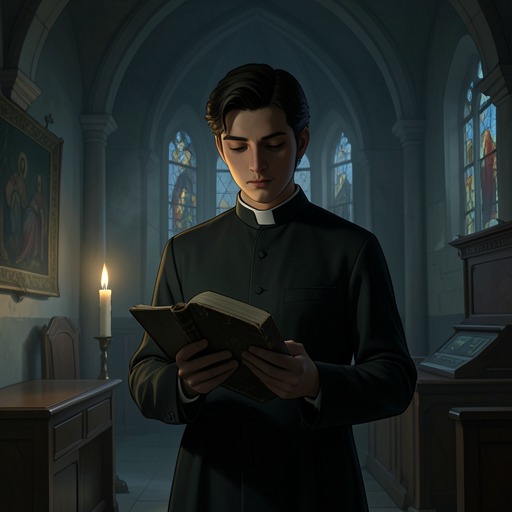
Before Coopers Chase became a retirement village, the hill was dominated by a convent belonging to the Sisters of the Holy Church. Matthew Mackie arrived from Ireland in 1967, aged twenty-five, and recalled a quiet, beautiful place occupied by about a hundred Sisters. He described a community where religious work, a busy hospital, sermons, and confessions formed part of daily life. His memories establish that the convent was not merely an earlier building on the site: it was an inhabited community with its own routines and history.
The Garden of Eternal Rest lay uphill from the convent, looking across the surrounding countryside. The Sisters were buried there over generations. That setting gives the later discovery of a concealed body a particular weight: it is found not in an anonymous patch of ground, but in a cemetery already understood as a place of burial and remembrance. The convent and cemetery preserve the physical setting of the 1970s even after the site has been transformed.
The transformation began after the Catholic Church sold the land. Coopers Chase was under construction roughly ten years before Joyce’s account, and its modern developments spread out from the old convent. In the present, the former religious grounds have become an elderly residential community, while the Garden of Eternal Rest is threatened by a development plan. The conflict over whether the cemetery should be moved therefore brings the site’s past into a current dispute over land and the treatment of the dead.
A burial dated by evidence, not certainty
The unidentified man’s burial is assigned to the 1970s through forensic estimation rather than a known date. After examining the bones and soil, Austin explains that the calculation has variables and cannot deliver certainty. His best estimate is that the body was buried sometime in the decade, probably toward its earlier part. The result places the burial more than fifty years before the investigation, but leaves its exact circumstances unresolved.
That uncertainty becomes a working problem for the Thursday Murder Club and the police. Elizabeth acknowledges that the group has secretly had the remains examined and then reburied them. She offers Chris and Donna a way to verify the finding through an official search: their own forensic team could examine the body and reach a similar conclusion about its sex and likely burial period. The proposed search is both a concession to the investigation and an attempt to turn the group’s unauthorized work into a usable lead.
The decade’s distance also complicates the search for a witness or suspect. Donna observes that the person who buried the body might have been present on the hillside in the 1970s and could still be there in the present. Gordon Playfair is considered as a possible source of memories because he lived nearby then and remains in the area, though Joyce notes that he was nowhere near Ian Ventham when Ventham was killed. The distinction matters: being able to illuminate the old history does not, by itself, make someone responsible for the present crime.
Memories reconstructed from local records
Gordon’s recollections become more useful when the group looks beyond memory alone. He remembers living with his young family in the same house on the hill when Coopers Chase was still a convent. At his home, he and the investigators go through photo albums, hoping that pictures taken during trips down the hill might identify someone connected to the burial.
The crucial material appears near the end of the second album. After wedding and family photographs, and many pictures of sheep, the group reaches six black-and-white images from a Christmas gathering at the convent. A group photograph prompts them to look again and agree that they have found evidence. The album does not explain the burial, but it converts the 1970s from a vague date into a community that can be examined: people once present at the convent may be recognizable across the decades.
Other records point toward an older criminal investigation. At lunch, Elizabeth brings a manila folder and asks Penny about a girl who had been stabbed. The old case is represented in the folder by typed pages and photographs; Penny’s squad had dealt with the boyfriend, who escaped while being taken for a police interview and was not seen again. The Thursday Murder Club understands that its private conclusions cannot themselves bring him to justice. Later, Elizabeth explains that Penny kept copies of files from her cases, and says that Karen Playfair’s recognition of John has led her to check one final detail in one of them. The file thus becomes a bridge between a past investigation and a present identification, although the surviving account does not disclose the detail Elizabeth is checking.
The past enters the present investigation
The buried man’s estimated date changes the scale of the current mystery. The Thursday Murder Club considers not only who placed a body in the cemetery, but whether the person responsible might still be close by. After Ian Ventham is found dead, Elizabeth raises the possibility that Ventham was murdered to keep the old burial secret. At that point it remains a question for the investigators, not an established explanation; the connection is compelling precisely because both the burial and the death demand answers.
The novel also makes the recovery of this history depend on interruptions and shared recollection. A dispute in the Cryptic Crossword Club postpones its meeting and leaves the Jigsaw Room free, where Matthew can sit with the Thursday Murder Club and Chris and Donna. His account of arriving in 1967 supplies a witness’s view of the convent before Coopers Chase, while Gordon’s album supplies visual evidence and Penny’s copied case files preserve investigative records. Different kinds of memory—testimony, photographs, and files—converge without making the past immediately transparent.
Narrative significance
The 1970s function as both a date and a limit on knowledge. The burial can be placed within a decade, but not fixed to a day; the people who lived or worked near the convent have aged, moved, or become difficult to identify; and the evidence has survived in imperfect forms. The investigation must therefore reconstruct events indirectly, testing recollection against material traces rather than treating memory as a complete account.
This backward inquiry also binds the novel’s separate mysteries together. The former convent grounds, the cemetery dispute, the old stabbing case, the hidden remains, and the death of Ian Ventham belong to different moments, yet each makes the past consequential in the present. The 1970s are not safely over: their unresolved burial and preserved records give the current investigators a route into what happened, while leaving them to distinguish a promising connection from proof.